If other states follow suit, it is going to become difficult for the GST Council to decide on the next stage of reforms.

Currently, domestic supplies and commercial imports of vaccines attract a 5 per cent Goods and Services Tax, while COVID drugs and oxygen concentrators attract a 12 per cent levy.

State FMs okay list of tax-exempt services with certain riders.

GST rates would depend upon whether the commodity is used by a rich person or a common man

The finance minister said the consensus between the Centre and states is required to amendment the constitution for implementing goods and services tax.

Amid an outcry over record high petrol and diesel prices, Union Finance Minister Nirmala Sitharaman on Saturday said the Centre and state governments will have to together work out a mechanism to bring retail rates to reasonable levels.

Last week, a Rajya Sabha committee had allocated five hours for discussion on GST.

The consensus was reached after the Centre agreed to the demand of states to go in for horizontal split

The GST revenues for August 2023 have shown a growth of 11 per cent year on year due to increased compliance and less evasion, Revenue secretary Sanjay Malhotra said on Friday. The collection from Goods and Services Tax (GST) was Rs 1,43,612 crore in August 2022. "Roughly numbers are in the range of 11 per cent year on year growth as in earlier months," Malhotra told reporters.

On Thursday, the Business Advisory Committee of the Lok Sabha, which allocates time for the Bills and discussions to be taken up for the forthcoming week, met, but the government strategists didn't ask the members to allocate time for the GST Bills for the next week.

Aiyar has contended that this results in revenue loss, malpractices and even death of people consuming illicit liquor

The GST Council, headed by Finance Minister Nirmala Sitharaman and comprising representatives of all states and Union territories, will have its 37th meeting in Goa against the backdrop of economic growth hitting a six-year low of 5 per cent in the first quarter of the current fiscal.
The Cabinet on Wednesday approved amendments to the GST bill to compensate states for revenue loss for five years on introduction of the uniform nationwide indirect tax regime.
Amid record-high fuel prices, Finance Minister Nirmala Sitharaman on Monday said there is no proposal as of now to bring crude oil, petrol, diesel, jet fuel (ATF) and natural gas under the Goods and Services Tax (GST). When the GST was introduced on July 1, 2017, amalgamating over a dozen central and state levies, five commodities - crude oil, natural gas, petrol, diesel, and aviation turbine fuel (ATF) - were kept out of its purview given the revenue dependence of the central and state governments on this sector. This meant that the central government continued to levy excise duty on them while state governments charged VAT. These taxes, with excise duty, in particular, have been raised periodically.

"To begin with, people could face some difficulties because any changeover has its own problems. But it will settle down and the country will benefit from the new indirect tax regime," Jaitley said at an event organised by ABP News.

Under the GST regime, most manufactured goods will turn cheaper.
Inching towards rolling out of GST, the GST Council on Saturday approved a law to compensate states for any loss of revenue from the implementation of the new national sales tax but deferred approval for enabling laws to next meeting.
Parliament on Thursday cleared the decks for the rollout of the historic Goods and Services Tax from July 1 as it approved four supporting legislations to usher in the one-nation-one-tax regime.

The Empowered Committee of state finance ministers is meeting under the chairmanship of West Bengal finance minister Asim Dasgupta to work out agreements on various aspects of the GST.

The FAQ also clarified that companies, including Titan, which supplies watches and jewels through their own websites will not be considered as e-commerce operators
Modi, who also handles the finance portfolio in the Bihar government, replaces Asim Dasgupta, who had served in the post for over a decade since the formation of the body.
With most states on board to raise revenue so that they do not have to depend on Centre for compensation, the GST Council at its meeting next month is likely to consider a proposal to do away with the 5 per cent slab by moving some goods of mass consumption to 3 per cent and the remaining to 8 per cent categories, sources said. Currently, GST is a four-tier structure of 5, 12, 18 and 28 per cent. Besides, gold and gold jewellery attract 3 per cent tax. In addition, there is an exempt list of items like unbranded and unpacked food items which do not attract the levy.

Singapore's single-rate GST structure cannot be India's model. But its practice of early announcement of rates much before their implementation should be emulated by India, says A K Bhattacharya.

Pulse oximeters, hand sanitisers, temperature check equipment and ambulances too will attract lower 5 per cent tax.
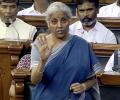
India is facing no risk of recession or stagflation as macroeconomic fundamentals of the economy are strong, Finance Minister Nirmala Sitharaman said on Monday. Replying to a debate on price rise in the Lok Sabha, she said the GST collection and Purchasing Managers' Index (PMI) are indicating that the Indian economy is getting more robust. The GST collection rose 28 per cent to touch the second-highest level of Rs 1.49 lakh crore in July. GST, introduced in July 2017, touched a record high of Rs 1.68 lakh crore in April 2022.

Rajya Sabha witnessed heated exchanges between the treasury and opposition benches after Congress leader Mallikarjun Kharge made remarks on the manner in which political parties select women candidates from weaker sections and raised the issue of 'delayed' GST payments to non-Bharatiya Janata Party ruled states.
Bengal Finance Minister Amit Mitra expressed confidence in GST.
No longer a discretion of the tax administrator, the audit of returns filed by taxpayers is now based on a selection by algorithms, notes Tarun Bajaj.

At his pre-Budget consultations with Finance Ministers of states, he is understood to have said that it was time to wrap up lose ends on GST.

Offering an olive branch to the Opposition to get the GST bill passed, Finance Minister Arun Jaitley on Thursday said that Prime Minister Narendra Modi is willing to speak to everyone to get the landmark indirect tax law through.

The GST Council, that includes representatives of all states, will meet again on November 3-4 to decide on the tax rates

A minimum levy of 12 per cent GST on tea will increase the cost, which will ultimately be passed on to consumers.

With 7 per cent economic growth, India is not creating enough jobs as reflected by the number of applicants for vacant posts in some states, Reserve Bank's former governor Raghuram Rajan said and suggested the government needs to focus on promoting labour-intensive industries to generate employment. Rajan further said some Indians, especially those at upper level, are comfortable and have high incomes, but consumption growth from the lower half of the country has still not recovered to pre-pandemic level.
Finance Minister Nirmala Sitharaman on Thursday said taxpayer base has almost doubled to 1.28 crore in four years of rollout of the historic tax reform and the enhanced GST mop up in the recent months should now be the "new normal". In a written message to tax officers on the fourth anniversary of GST rollout, she said implementing any reform of this scale in a large and diverse country like India can be highly challenging, but GST has brought about ease in taxpayer compliance and reduced common man's tax burden.

The GST rate on mobile phones will be hiked to 18 per cent while that on maintenance repair overhaul (MRO) services for aircraft will be lowered to 5 per cent with effect from April 1, Finance Minister Nirmala Sitharaman said on Saturday. The GST rate on handmade and machine-made matchsticks has been rationalised to 12 per cent from 5 per cent and 18 per cent respectively.

Restricting the input credit is not a good idea for any sector, particularly real estate which requires more formalisation.
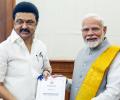
With its age-old fascination for education, southern states have done better than the North. Start-ups, IT hubs, and industry majors setting up shop have changed the face of the South. Nearly 79% of global offices set up by international conglomerates in India are in the South. Almost 46% of tech unicorns are from the South. The GDP per person in the South is 4.2 times higher than the North. None of these indicators can be ignored by any central government, whatever the political compulsions, notes Ramesh Menon.

The Centre and states are likely to settle for this threshold.

'Modi had not discussed demonetization with me prior to his announcement on 8 November 2016. 'I learnt of it along with the rest of the country. 'I was not surprised when he did not discuss the issue with me prior to making the public announcement. 'It fitted in with his style of making dramatic announcements.' A fascinating excerpt from Pranab Mukherjee's The Presidential Years: 2012-2017.

According to the Minister, GST proposals would help in spurring growth and employment.
